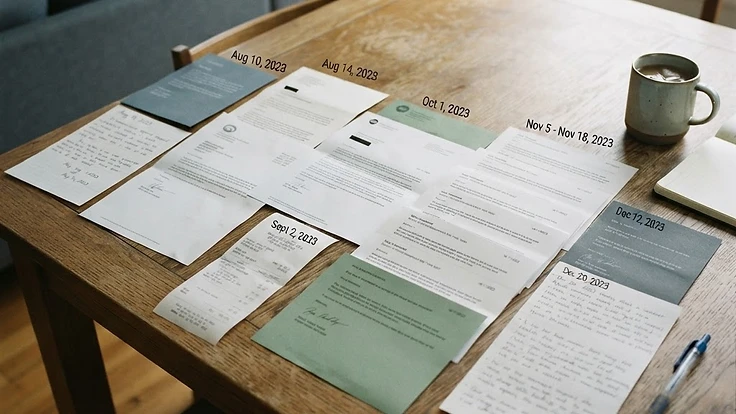
Rental Dispute Record-Keeping: Build a Timeline That Speaks for Itself
When a rental dispute grows, memory fades and stories conflict. Learn what a factual housing record is — and how to keep one that stands on its own.
- Jurisdiction
- North Carolina — Official NC General Statutes (N.C.G.S. Chapter 42)
- Last Reviewed
- September 2026
- Reading Time
- 3 min
What to know
In North Carolina, repair and maintenance rights is governed by N.C.G.S. § 42-42 (landlord's duties), and the deadlines that statute sets are what protect your money and your record. Circuit Facts™ is a free logging tool that keeps your lease dates, charges, and repairs together in one dated Housing Record.
What This Guide Covers
This guide covers: North Carolina landlord-tenant law runs on facts and dates · What a good record is — and is not · One record for one lease · Every incident keeps its own timeline · Export when it matters.
What the Rule Says
Why does North Carolina landlord-tenant law run on facts and dates?
Late fees are capped by N.C.G.S. § 42-46. Security deposits are capped and accounted under N.C.G.S. §§ 42-50 to 42-56. Your landlord's repair duties come from N.C.G.S. § 42-42.
Every one of these rules turns on specifics: when notice was given, how much was charged, when keys went back. That is exactly what a record keeps.
What makes a good rental record, and what does not?
A good record does not argue. It shows: what happened, when it happened, what was said, and what proof exists.
It is not a diary of feelings or a list of accusations. Neutral facts, dated and sourced, are what hold up.
Practical Guidance
Why should you keep one record for one lease?
A Housing Record holds every fact for one lease: incidents, notices, fees, deposit facts, and evidence — each with its own date.
How does every incident keep its own timeline?
Log what you noticed, when you reported it, what came back, and what changed. Attach proof to each step so the timeline shows sources, not just memories.
When should you export your rental record?
When you need it, export a dated PDF of your housing record to share with a mediator, legal aid, or your landlord.
Official Sources
Official NC General Statutes (N.C.G.S. Chapter 42)
Official NC General Statutes (N.C.G.S. Chapter 42)
Migrated from the article citation list
Last checked: September 2026N.C.G.S. § 42-42 (landlord's duties)
N.C.G.S. § 42-42 (landlord's duties)
Migrated from the article citation list
Last checked: September 2026N.C.G.S. § 42-46 (fees)
N.C.G.S. § 42-46 (fees)
Migrated from the article citation list
Last checked: September 2026N.C.G.S. §§ 42-50 to 42-56 (Security Deposit Act)
N.C.G.S. §§ 42-50 to 42-56 (Security Deposit Act)
Migrated from the article citation list
Last checked: September 2026
Related Guides
Rent Abatement in North Carolina: Can You Get Money Back When Your Landlord Fails to Make Repairs?
Rent abatement may compensate North Carolina tenants when a landlord’s failure to maintain the home reduces its fair rental value. Learn how courts calculate it, the evidence you need, why you cannot simply withhold rent, and how UDTP claims differ.
Read the articleWhen Your Landlord Won't Fix It: Understanding Your Repair Rights in North Carolina
North Carolina landlords must keep rentals fit and habitable under N.C.G.S. Chapter 42. Learn what the law requires, when plumbing leaks or flooding become habitability problems, why you generally cannot withhold rent, and what to do instead.
Read the articleHow to Document a Repair Request in North Carolina (And Why It Matters)
NC law requires landlords to maintain rental units in habitable condition. Here is how to submit and document a repair request so your record is clear if the problem is not fixed.
Read the article