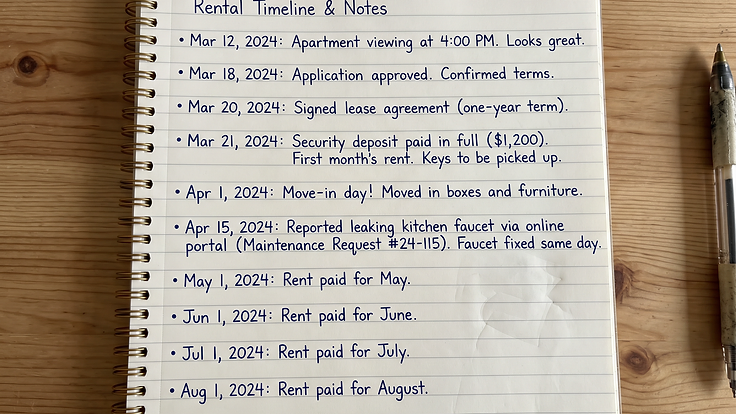
How to Build a Rental Timeline in North Carolina
From first notice to final accounting, NC landlord-tenant law runs on dates. Learn how to build a rental timeline that keeps every fact in order.
- Jurisdiction
- North Carolina — Official NC General Statutes (N.C.G.S. Chapter 42)
- Last Reviewed
- September 2026
- Reading Time
- 2 min
What to know
In North Carolina, repair and maintenance rights is governed by N.C.G.S. § 42-42 (landlord's duties), and the deadlines that statute sets are what protect your money and your record. Circuit Facts™ is a free logging tool that keeps your lease dates, charges, and repairs together in one dated Housing Record.
What This Guide Covers
This guide covers: Many rules are really deadlines · Sourced events beat remembered ones · Every incident gets its own timeline · Add events as they happen — or from papers you kept · Export the whole story.
What the Rule Says
Why do so many renter rules come down to deadlines?
Rent must be at least five days late before a late fee can be charged, and late fees are capped. (N.C.G.S. § 42-46.)
Deposit accounting is due within 30 days after the tenancy ends — or within 60 days of an interim accounting. (N.C.G.S. § 42-52.)
A timeline keeps those dates straight: when a problem started, when you reported it, and what the landlord did next.
Why do sourced events beat remembered ones in a rental dispute?
An event backed by a portal screenshot, a text message, or a letter is stronger than an event from memory alone. Keep the source with the event.
Practical Guidance
How does each incident keep its own timeline?
In your Housing Record, each incident keeps a timeline of events. Every event has a date you enter, a source, and optional proof — not a system timestamp.
When should you add events to your rental timeline?
Log landlord responses, repair visits, and condition changes as they happen. For past events, use the dates on the documents you kept.
How do you export your full rental timeline?
When you are ready, export a dated PDF of your housing record — timeline, events, and evidence inventory together.
Official Sources
Official NC General Statutes (N.C.G.S. Chapter 42)
Official NC General Statutes (N.C.G.S. Chapter 42)
Migrated from the article citation list
Last checked: September 2026N.C.G.S. § 42-42 (landlord's duties)
N.C.G.S. § 42-42 (landlord's duties)
Migrated from the article citation list
Last checked: September 2026N.C.G.S. § 42-46 (late fees)
N.C.G.S. § 42-46 (late fees)
Migrated from the article citation list
Last checked: September 2026N.C.G.S. § 42-52 (deposit accounting deadlines)
N.C.G.S. § 42-52 (deposit accounting deadlines)
Migrated from the article citation list
Last checked: September 2026
Related Guides
Rent Abatement in North Carolina: Can You Get Money Back When Your Landlord Fails to Make Repairs?
Rent abatement may compensate North Carolina tenants when a landlord’s failure to maintain the home reduces its fair rental value. Learn how courts calculate it, the evidence you need, why you cannot simply withhold rent, and how UDTP claims differ.
Read the articleWhen Your Landlord Won't Fix It: Understanding Your Repair Rights in North Carolina
North Carolina landlords must keep rentals fit and habitable under N.C.G.S. Chapter 42. Learn what the law requires, when plumbing leaks or flooding become habitability problems, why you generally cannot withhold rent, and what to do instead.
Read the articleHow to Document a Repair Request in North Carolina (And Why It Matters)
NC law requires landlords to maintain rental units in habitable condition. Here is how to submit and document a repair request so your record is clear if the problem is not fixed.
Read the article